
## Metadata
- Author: [[roger-peng|Roger Peng]]
- Full Title:: Tukey, Design Thinking, and Better Questions
- Category:: #🗞️Articles
- Document Tags:: [[Data analysis|Data analysis]], [[to-share-colleagues|To Share (colleagues)]],
- URL:: https://simplystatistics.org/posts/2019-04-17-tukey-design-thinking-and-better-questions/
- Finished date:: [[2024-11-20]]
## Highlights
> Maybe what we spend most of our time doing is figuring out a better question. ([View Highlight](https://read.readwise.io/read/01jcwznxnk8wzvdns45tt6brnd))
> It’s the first “diamond” in the [“double diamond”](https://simplystatistics.org/2018/09/14/divergent-and-convergent-phases-of-data-analysis/) approach to design. ([View Highlight](https://read.readwise.io/read/01jcwzp0m98rxck6snzeaage6y))
> • You’re probably asking the wrong question anyway, so don’t take yourself too seriously;
> • The “best” approach is only defined as “best” according to some arbitrary criterion that probably isn’t suitable for your problem/question. ([View Highlight](https://read.readwise.io/read/01jcx0hgs8dtv1rg99z8ma4mxz))
> 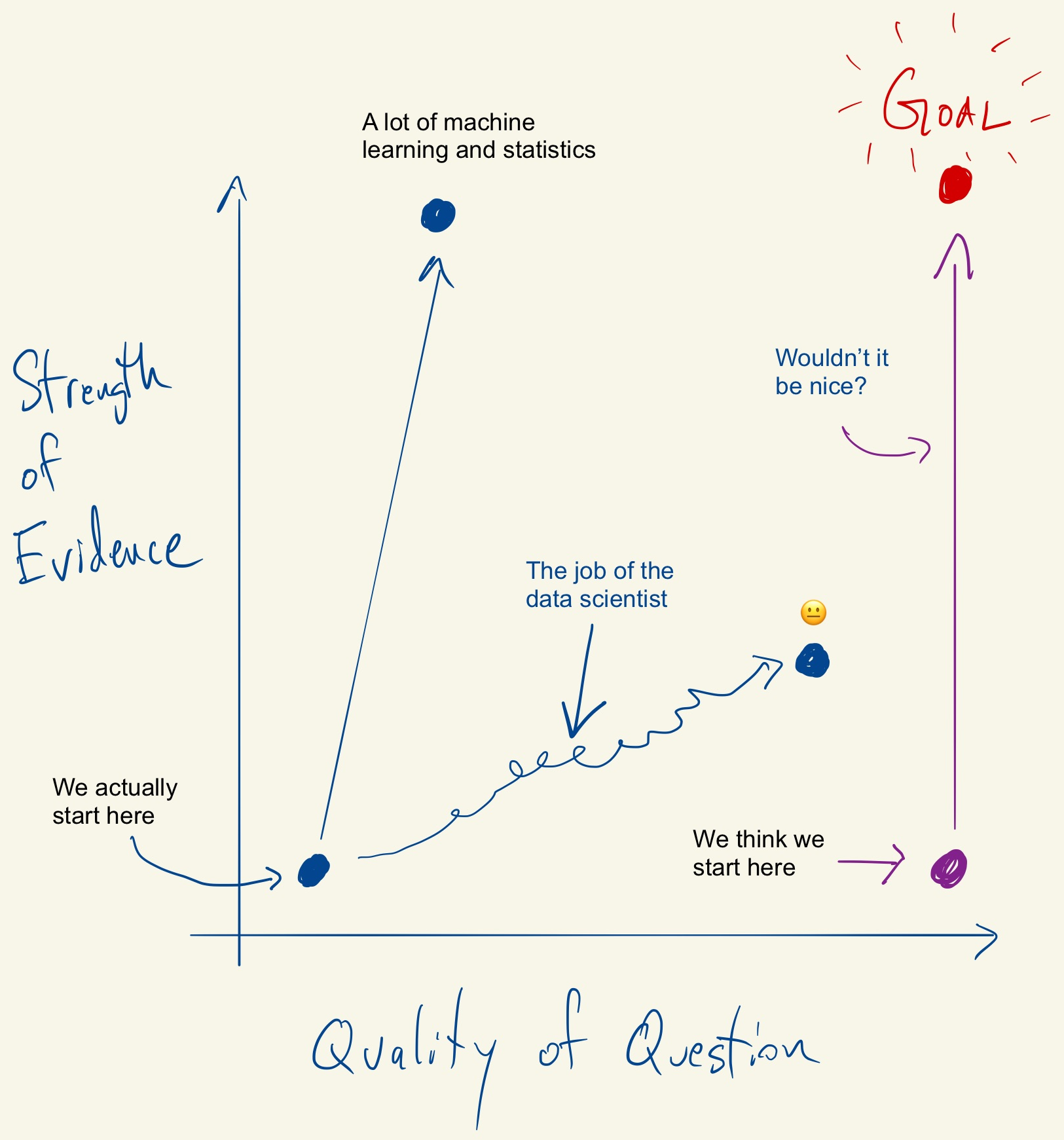 ([View Highlight](https://read.readwise.io/read/01jcx0j53h4qwfbwkq8xjbzepb))
>  ([View Highlight](https://read.readwise.io/read/01jcx0j54awzq8qdbpmhab3akq))
> In my view, the most useful thing a data scientist can do is to devote serious effort towards improving the quality and sharpness of the question being asked. ([View Highlight](https://read.readwise.io/read/01jcx0jfv2gbke9wsp62s9jt90))
> The following is from the very opening of Tukey’s book *Exploratory Data Analysis:
> > It is important to understand what you CAN DO before you learn to measure how WELL you seem to have DONE it ([View Highlight](https://read.readwise.io/read/01jcx0m5v89kkrjwyeej23qxcr))
> It is the residuals that really let you learn about the data, discover whether there is anything unusual, whether your question is well-formulated, and how you might move on to the next step. So in the end, you got row medians, column medians, *and* residuals, i.e. more data. ([View Highlight](https://read.readwise.io/read/01jcx0n8sw0a8nf3hqsbg60456))