## Metadata
- Author: [[brittany|Brittany]]
- Full Title:: The Revolving Door of BI
- Category:: #🗞️Articles
- Document Tags:: [[bi|Bi]],
- URL:: https://datafordoers.substack.com/p/the-revolving-door-of-bi?ref=blef.fr
- Finished date:: [[2024-08-25]]
## Highlights
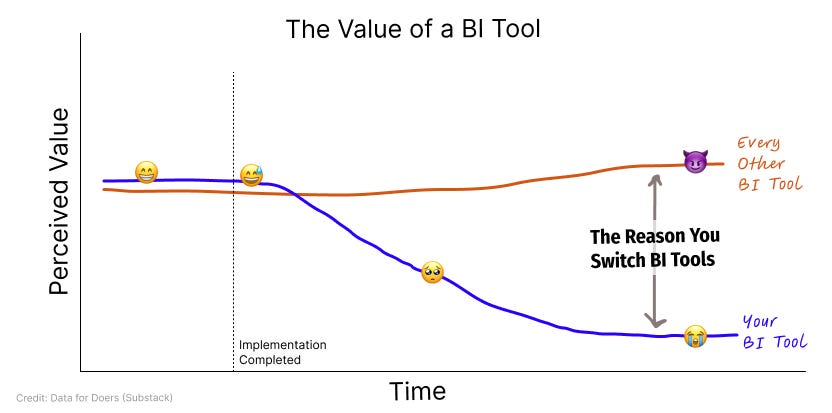
> On a technical level - this presents a problem. It’s not easy to evolve the underlying data models. Especially as users are trying to do more “self-serve analytics” with their reporting tools, they’ll ask for one-off dimensions to be added to a dashboard (e.g., “A flag for customers who have purchased the same product twice within 48 hours” or “Last-touch attributed channel, but excluding email”). The data models quickly become a tangled mess of limited-purpose logic to incorporate new dimensions, filters, metrics, and data sources. ([View Highlight](https://read.readwise.io/read/01j631pkc6j9pn03txx0bvc546))
> I’m skeptical that an LLM on top of the wild-west of a messy data warehouse can deliver the reliable results users need. Alternatively, an LLM querying a well-governed data model will face the same challenges as traditional BI tools. We will still need a flexible way to interact with and evolve our data models over time. ([View Highlight](https://read.readwise.io/read/01j631tmd3tp9z4031m0wds3aa))