
## Metadata
- Author: [[google-cloud|Google Cloud]]
- Full Title:: LookML terms and concepts
- Category:: #🗞️Articles
- Document Tags:: [[looker|Looker]],
- URL:: https://cloud.google.com/looker/docs/lookml-terms-and-concepts
- Finished date:: [[2023-06-27]]
## Highlights
> 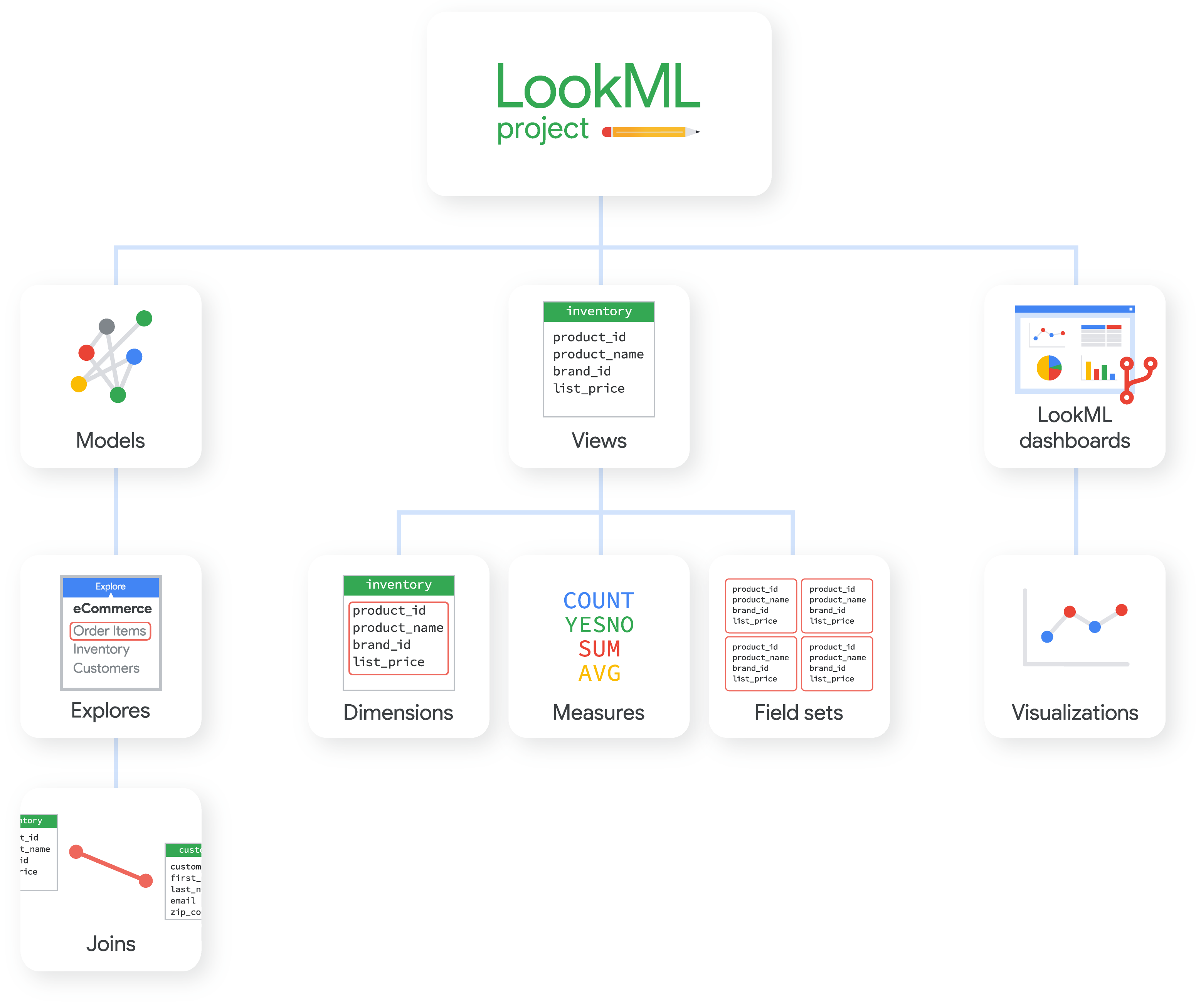 ([View Highlight](https://read.readwise.io/read/01h3wmtjvcj1sbfcvzdrf27gpq))
> When you generate a new project from your database, Looker creates a baseline set of files that you can use as a template for building out the project:
> • Multiple [view](https://cloud.google.com/looker/docs/lookml-terms-and-concepts#view) files, one file for every table in the database.
> • One [model](https://cloud.google.com/looker/docs/lookml-terms-and-concepts#model) file. The model file declares an [Explore](https://cloud.google.com/looker/docs/lookml-terms-and-concepts#explore) for every view. Each Explore declaration includes [`join`](https://cloud.google.com/looker/docs/lookml-terms-and-concepts#join) logic to join any view that Looker can determine is related to the Explore. ([View Highlight](https://read.readwise.io/read/01h3wmtyrejwv1dhwbbkd8dbzh))
> Each model can expose different data to different users. For example, sales agents need different data than company executives, and so you would probably develop two models to offer views of the database appropriate for each user. ([View Highlight](https://read.readwise.io/read/01h3wmx88ckshgytv3eywgrcbg))
> A view declaration defines a list of [fields](https://cloud.google.com/looker/docs/lookml-terms-and-concepts#field) (dimensions or measures) and their linkage to an underlying table or derived table. In LookML a view typically references an underlying database table, but it can also represent a [derived table](https://cloud.google.com/looker/docs/lookml-terms-and-concepts#derived-table). ([View Highlight](https://read.readwise.io/read/01h3wn544n9m07jesv2qvp89xh))
> An [Explore](https://cloud.google.com/looker/docs/exploring-data) is a view that users can query. You can think of the Explore as a starting point for a query, or in SQL terms, as the `FROM` in a SQL statement. Not all views are Explores, because not all views describe an entity of interest ([View Highlight](https://read.readwise.io/read/01h3wn5v3hzs9g172wen6pmp9c))
> The views `orders` and `customers` that are referenced within the `explore` declaration are defined elsewhere, in their respective view files. ([View Highlight](https://read.readwise.io/read/01h3wny7ddwjhhkz3am1vg701p))
> connection: order_database include: "filename_pattern" explore: orders { join: customers { sql_on: ${orders.customer_id} = ${customers.id} ;; } } ([View Highlight](https://read.readwise.io/read/01h3wn6wbn2j291pxptw9ya8cd))
> In Looker, a **set** is a list that defines a group of fields that are used together ([View Highlight](https://read.readwise.io/read/01h3wndqcxkpfydft55181jf9c))
> used to specify which fields to display after a user [drills down](https://cloud.google.com/looker/docs/lookml-terms-and-concepts#drill) into data ([View Highlight](https://read.readwise.io/read/01h3wnzdym216m4s8djnmnw5c1))
> A *derived table* is a query whose results are used as if it were an actual table in the database ([View Highlight](https://read.readwise.io/read/01h3wp4zhpx0f6jen2eqckb91q))