## Metadata
- Author: [[motif-analytics|Motif Analytics]]
- Full Title:: Introducing Sequence Analytics
- Category:: #🗞️Articles
- Document Tags:: [[sql|Sql]], [[sql|Sql]], [[Product analytics and sequence analytics|Product Analytics And Sequence Analytics]]
- URL:: https://motifanalytics.medium.com/introducing-sequence-analytics-93eadd921440
- Finished date:: [[2023-08-10]]
## Highlights
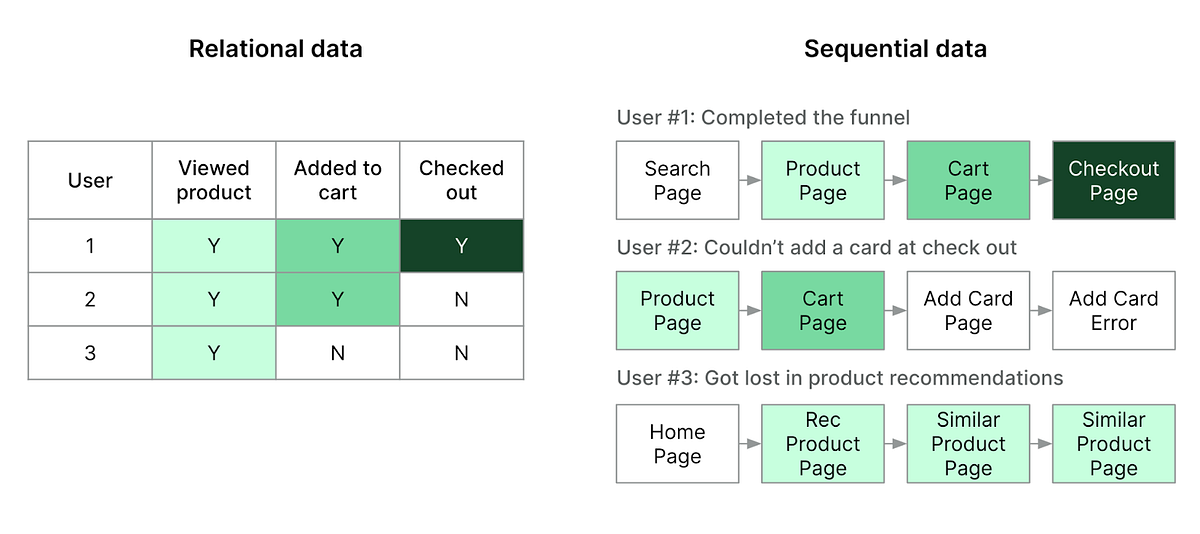
> Questions like this one, which rely on ***order or duration between events***, are hard to approach using relational data and SQL. They usually involve 50+ lines of window functions and/or self-joins with all the ensuing debugging ([View Highlight](https://read.readwise.io/read/01h7dzrhc5gk2015mcwpg10c48))
> Complex systems can be described through their ***state*** or ***history***. For example, the game of chess is usually specified ([View Highlight](https://read.readwise.io/read/01h7dzw7hjyve10dhmj23d6kpw))
> Most analytics data comes in as “history” (events) but analytics in data warehouses today is done through the “state” ([View Highlight](https://read.readwise.io/read/01h7dzwjzq0vw9w77dfkqmjywn))